All You Really Need Is A Mic And An Idea

Podcasting Continues to Grow in Popularity at the Digital Humanities Center
According to the Pew Research Center (2025), “Americans are increasingly tuning into podcasts, and … [podcasts] have become a large part of many U.S. adults' everyday lives.” Podcasts - digitally recorded audio or video files that can be downloaded or streamed for later listening or viewing - are especially important for understanding the information needs of the SDSU community, with Pew reporting that 39% of adults under the age of 50 identify podcasts as a significant source for news. Macalester College identifies podcasting as an important feature of the “digital liberal arts,” with assignments being used across disciplines to “[help] hone research and interview skills and [integrate] layered and nuanced storytelling” into higher education. This is definitely the case at SDSU, and our home for podcasting is in the Digital Humanities Center (DHC).
Founded in 2017, the DHC brings students and faculty together to study digital technologies and culture, employ computational practices in research and teaching, and reflect upon the impact of the digital on our lives. Since its return to in-person programming following the COVID-19 pandemic (during which it provided groundbreaking support for online teaching, learning, and research), the DHC has seen tremendous growth in its programs, especially podcasting.
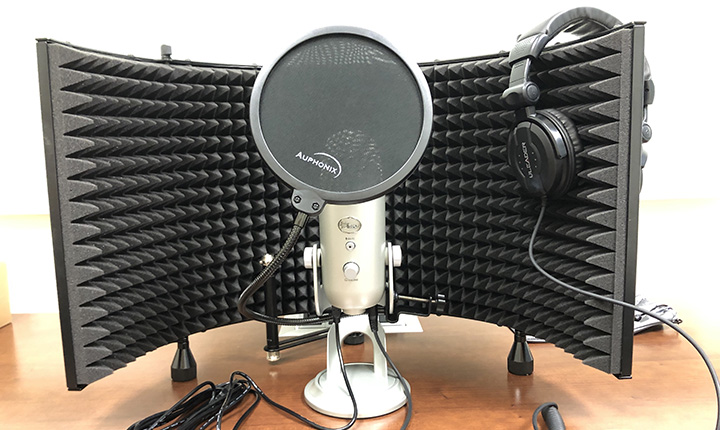
The first podcasting studio, created in 2018, was a low-tech portable option that featured a single Blue Yeti USB microphone with cheap headphones, a tabletop phone shield for minimal sound dampening, and a bulletin board to share resources.
In 2019, Pamella R. Lach, Digital Humanities Librarian and DHC director, began a collaboration with the National Humanities Center and hosted a group of graduate students for a summer podcasting intensive workshop. Over the next five years, the DHC hosted 10 institutes, expanding to include faculty, academic workers, and independent scholars. Interdisciplinary cohorts learned how to quickly move through the full podcast production lifecycle as they explored new ways of engaging in public scholarship.“Over five years," Lach said, "I trained more than 600 people across the US and beyond. These participants went on to launch their own podcasts, become podcast producers, and teach their students to podcast.
Lach sees a sharp rise in DH instruction requests, as many faculty seek to experiment in the classroom, responding in part to the rapid rise of Generative AI. Across the disciplines, faculty are pursuing critical-creative assignments that encourage students to think carefully about their relationship to technology while also honing their technology skills. In a talk at the Lincoln Center for Applied Ethics at Arizona State University, Lach said, "Just as podcasting served as a way to forge human connection throughout the pandemic, so too can it serve as a way to tend to human relationships in this age of AI, a way to wade through the noise to create authentic, imperfect stories that capture the multitudes of human experiences.”
Reflecting the trends suggested by Pew, demand for instruction in podcasting has increased by more than 300% over the past three years. Each year, more courses from across campus incorporate podcasting into their assignments, from large Journalism and Media Studies classes to the College of Education’s doctoral program in Community College Leadership.
The DHC also supports SDSU staff, faculty, and students' use beyond the classroom, including by publishing ongoing podcasts such as the Faculty Futures Lab, produced in collaboration with the Center for Teaching and Learning. The DHC website links to many of the podcasts created in their studios. Interest in podcasting continues to increase exponentially across the curriculum (nearly 40 programs across eight colleges) and individual recording sessions (from 96 in AY22-23 to 662 in AY25-26).
Patrick Flanigan, Programs and Operations Specialist, has been instrumental to the podcasting program, offering both technical expertise and creative guidance. It's been under his leadership that the DHC has been able to scale up the infrastructure and support for podcasting. Today, there are five professional-quality podcasting studios available for use. His efforts were recognized in 2025 with the Presidential Staff Excellence Award for Innovation and Creativity.
The DHC continues to expand its podcasting support. Lach said, “We offer class instruction, asynchronous learning resources, workshops and trainings, and consultation to help people throughout the entire podcast life cycle. We've launched a publishing platform to host shows for our campus partners and developed a workflow for depositing episodes into our institutional repository. Every piece of technology, indeed, every intervention we develop is in response to community need.”
A group of student employees rounds out the staff. These students learn tangible skills producing their own show, CHAT DHC, while they assist with podcasting appointments and support ongoing programs in the DHC. Together, the entire team makes the DHC a welcoming and engaging space.
Flanigan and the DHC staff are also supporting efforts to grow podcasting at SDSU Imperial Valley.
As the popularity of podcasting continues to grow, the DH Center is here to help make your idea a reality. Students, staff and faculty can use the studios for a class assignment (be that teaching or learning), a personal project, or for professional development.
Book a podcasting studio today and begin your journey!